Types of tractionary batteries: complete guide by technology and application
Types of tractionary batteries are organized by assembly format - 2V cells combined in custom-built battery cases or ready-to-use monoblocs - and by construction technology, dominated by flooded lead-acid batteries with high-antimony grids, designed for daily deep discharge.
In practice, the right type starts with the equipment: the nominal voltage, available compartment, and operating conditions determine the configuration - not the other way around.
This guide presents each type, its typical applications, and the criteria that determine the right choice.
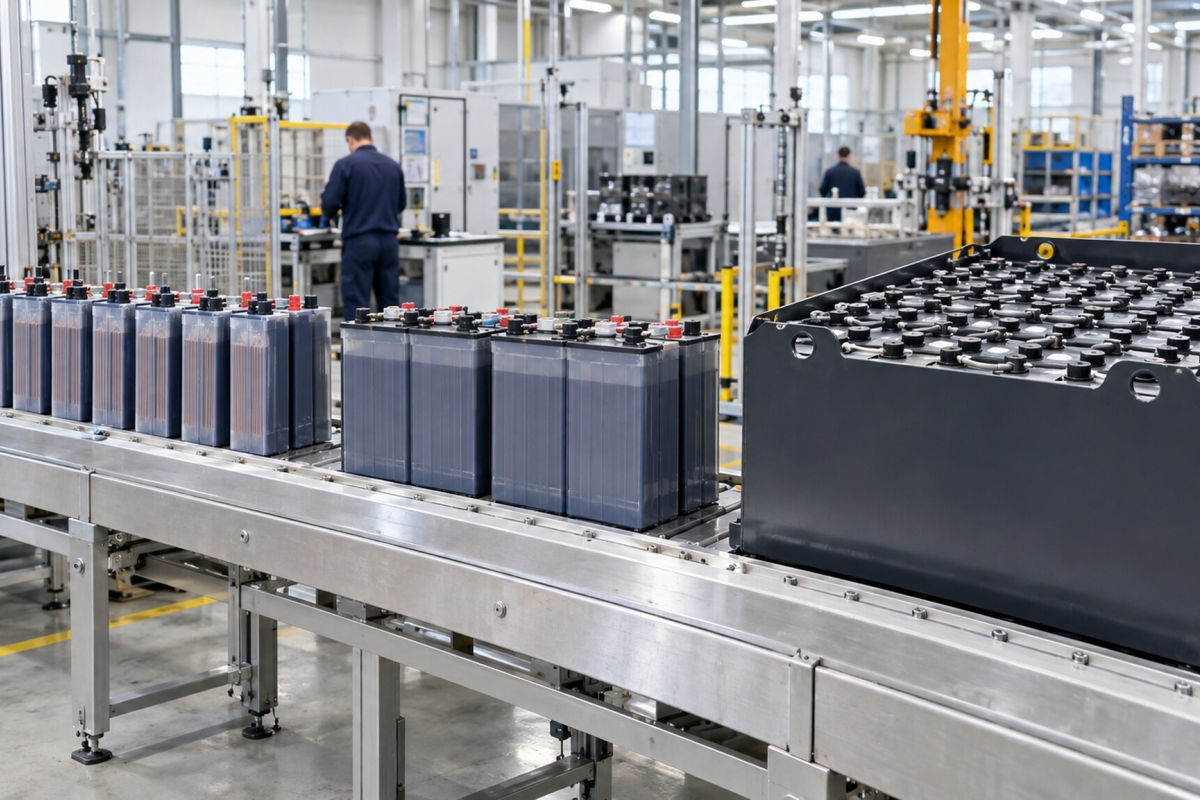
2V cells: the foundation of industrial tractionary batteries
The tractionary battery cell is a 2V cell - the fundamental unit. Cells are connected in series inside metal battery cases manufactured to fit the equipment compartment: 12 cells form 24V, 24 form 48V, and 40 form 80V.
This is the configuration used in forklifts and larger equipment for two reasons: complete flexibility in voltage and capacity, and cell-by-cell maintenance - a faulty cell can be diagnosed and serviced individually by measuring the electrolyte density of each one.
Monoblocs: practicality for smaller equipment
The monobloc combines the cells in a single polypropylene case with a sealed cover - in the Tudor line, with sedimentation chambers, reinforced H.D. connectors, and high-strength plate welding. This is the typical format for pallet trucks, walkie pallet trucks, smaller platforms, and light electric vehicles, where the compartment calls for a compact and easy-to-install solution.
The technology: high-antimony flooded lead-acid
The heart of any tractionary battery is the grid alloy: the high antimony content gives the plates the mechanical strength needed to withstand significant discharge depths, cycle after cycle - the deep cycle concept taken to an industrial operating regime, far beyond what a starting battery could tolerate.
Because it is a flooded technology with liquid electrolyte, it requires the maintenance routine that defines its service life: topping up with demineralized water after a full charge, periodic equalization, and density control (reference value of 1.265 g/cm³) - a discipline detailed in the Complete Guide to Tractionary Batteries.
Configurations by application
| Application | Typical voltage | Usual configuration |
|---|---|---|
| Pallet trucks and walkie pallet trucks | 24V | Monobloc or cells |
| Electric forklifts | 24V, 48V or 80V | Cells in custom-built battery case |
| Lifting platforms | 24V or 48V | Monobloc or cells |
| Sweepers and scrubbers | 24V or 36V | Monobloc |
| Shunting locomotives | 32V and 64V | Sets from 140Ah to 440Ah |
The voltage must always follow the equipment nameplate; capacity in Ah is sized according to the shift's consumption with a safety margin - the fundamentals are covered in the article about what a tractionary battery is and where it is used.
How to choose between the types?
· Equipment nominal voltage: non-negotiable, defined by the manufacturer.
· Compartment: dimensions and weight - in a forklift, the battery also serves as a counterweight.
· Shift pattern: 2- and 3-shift operations require spare batteries and a properly structured charging room.
· Available maintenance: cells allow cell-by-cell diagnosis; monoblocs simplify routine maintenance.
· Working environment: vibration and severe operating conditions are design assumptions for tractionary batteries.
Service life: what changes between the types?
The technological basis is the same, so cycle life depends less on the format and more on the operating routine: depth of discharge, full recharge after use, timely demineralized water replenishment, and periodic equalization. The advantage of cells is diagnosis: cell-by-cell density measurements make it possible to identify and service a weak cell before it affects the entire set.
With a monobloc, the reading is taken at the set level - making disciplined charging and water maintenance even more decisive for reaching the designed service life.
How does Tudor configure each application?
The Tudor Tractionary Battery line produces cells and monoblocs with factory application engineering: the team specifies voltage, capacity, and battery case for each piece of equipment - from pallet trucks to shunting locomotives - with quality management certified to ISO 9001, and ISO 14001 and IATF 16949 at the Bauru/SP facility. For stationary applications, the portfolio is complemented by the stationary battery line.
Conclusion
Cells for flexibility and large equipment, monoblocs for compactness and practicality - all based on the same high-antimony technology designed for daily deep cycling. The right type is the one determined by the equipment and operation.
To specify the exact configuration for your equipment fleet, visit which tractionary battery to choose and request a quote from a Tudor specialist.
Frequently Asked Questions
What are the types of tractionary batteries?
By assembly: 2V cells combined in custom-built battery cases, or monoblocs with the cells housed in a single case. The dominant technology is flooded lead-acid with high-antimony grids.
What is a tractionary battery cell?
It is the 2V cell, the basic unit of a tractionary battery. Cells connected in series provide the equipment voltage: 12 cells for 24V, 24 for 48V, and 40 for 80V.
What is the difference between a cell and a monobloc?
Cells are individual units assembled in a custom-built battery case, allowing cell-by-cell maintenance; a monobloc combines the cells in a single compact case, typical of smaller equipment.
What type of battery does an electric forklift use?
Generally, 2V cells in a custom-built battery case, at the equipment's required voltage (24V, 48V, or 80V), with capacity sized for the work shift.
Does a tractionary battery require maintenance?
Yes: topping up with demineralized water after a full charge, periodic equalization, and electrolyte density control, according to the technical manual.
Can I replace only one cell in a tractionary battery?
In many cases, yes - this is one of the advantages of cell-based assembly. The assessment is technical: density, the age of the battery set, and its overall condition determine whether a single-cell replacement is worthwhile.