How to Safely Test Your Car Battery at Home
When a car starts showing difficulty starting, intermittent electrical failures, or strange behavior on the dashboard, the battery is often the first suspect. At these times, it’s common to wonder if it’s possible to perform some kind of test at home without immediately going to a workshop. The good news is that yes, it is possible to safely test your car battery at home, as long as the driver understands the limitations of this type of check. A home test helps identify early signs of wear and discharge situations, but it does not replace a complete technical analysis. In this guide, you will learn how to safely assess the battery at home, what to observe even before using tools, and when it’s the right time to seek professional diagnostics.

Is it possible to test the car battery at home?
Yes, basic tests can be performed at home to check whether the battery is discharged or showing clear signs of loss of efficiency. These tests help prevent unexpected breakdowns but do not replace a complete technical evaluation.
They indicate when something is abnormal but cannot assess the battery’s internal capacity, which degrades over time—mainly due to improper habits, as explained in the article about mistakes that reduce battery life.
What signs indicate a weak battery?
Even before using any tools, the car’s behavior can provide important clues, such as:
- Slower engine start
- Flickering dashboard lights
- Infotainment system rebooting
- Intermittent failures
These signs are detailed in the content about signs of a weak battery and usually appear long before the battery stops functioning completely.
What can be visually checked on the battery?
A simple visual inspection can reveal relevant problems. Corrosion on terminals, loose or dry cables, or even deformation of the battery casing indicate that it is operating outside ideal conditions.
These issues increase electrical resistance and contribute to cases where the battery discharges quickly, even when the car is used regularly.
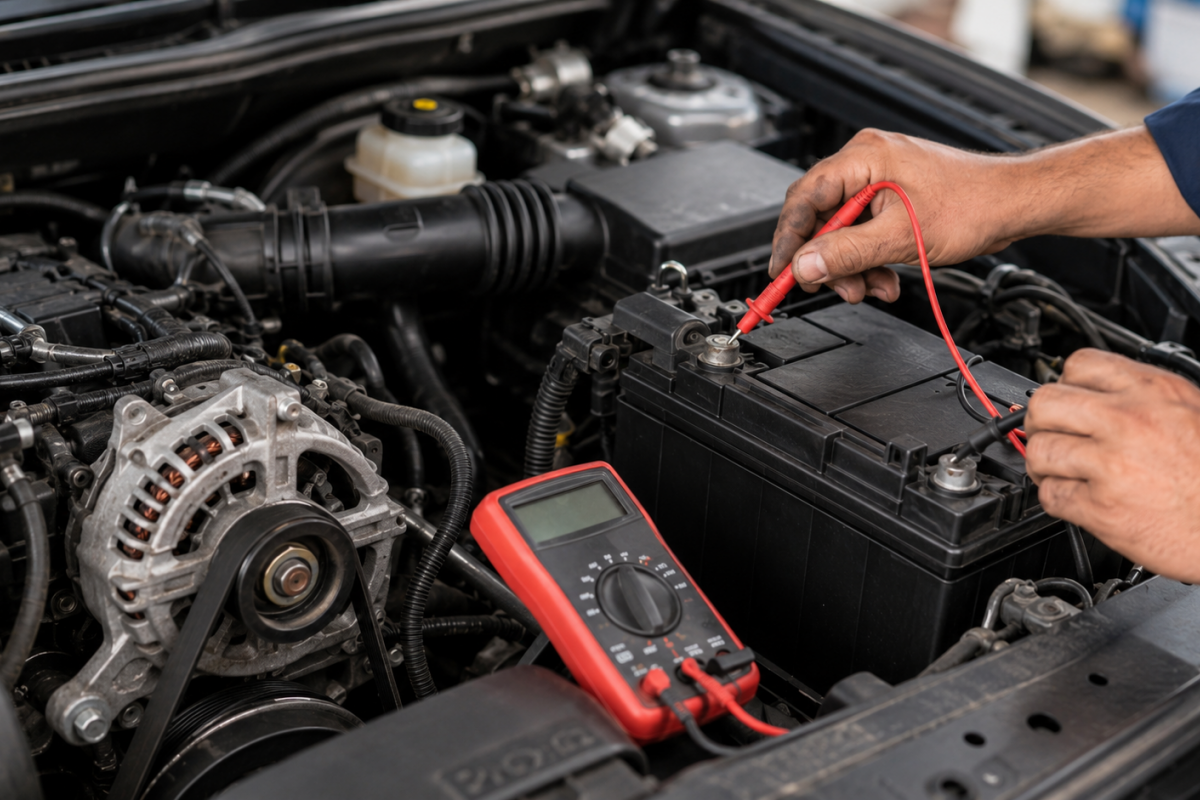
How to test the battery with a multimeter at home
A multimeter is the most accessible tool for a basic test. With the car turned off, measuring the voltage at the battery terminals shows the current charge level.
- Values near 12.6V indicate a fully charged battery
- Readings below 12.2V suggest discharge or wear
This test shows the state of charge, but it does not measure the actual current delivery capacity, explained in the article what is CCA of a battery.
What does voltage drop during starting mean?
Observing the voltage drop at the moment of engine start is one of the most revealing tests. When voltage drops sharply, even if the car still starts, it indicates internal capacity loss.
This is a classic sign of battery aging and usually precedes the need for replacement, a topic directly connected to the step-by-step automotive battery replacement guide.
How to know if the alternator is charging correctly
With the engine running, the measured voltage should be between 13.5V and 14.5V. Values outside this range indicate a charging system fault.
When the alternator isn’t working properly, even a new battery experiences the same wear as an old one—a common situation in vehicles where the battery discharges quickly even after replacement.
Is testing batteries in Start-Stop cars different?
Yes. Vehicles with Start-Stop systems use EFB or AGM batteries, which behave differently from conventional batteries.
In these cases, voltage may appear normal even with advanced internal wear. That’s why home tests are even more limited, as explained in the content about AGM and EFB batteries.
When is a home test no longer enough?
If the car continues to show frequent failures, the battery discharges easily, or the vehicle has many electronic modules, a home test is insufficient.
In these situations, only professional conductivity and CCA tests can indicate the battery’s real condition and prevent unnecessary replacements.
Summary, Testing your car battery at home is a valid practice, as long as it is done safely and with an understanding of its limits. Observing signs, performing simple measurements, and acting preventively helps avoid unexpected breakdowns and incorrect decisions.
To deepen your diagnostics, understand battery technologies, and avoid common mistakes, explore other technical content on the Tudor blog. Whenever in doubt about the battery’s condition or the correct application for your vehicle, consulting Tudor’s technical team is the safest way to ensure peace of mind in daily use.
Read also

What happens when a car sits unused for a long time?
Not every vehicle is driven long distances every day. Many people own a second car, use their vehicle only on weekends, or leave it unused during extended trips. Although this situation may seem harmless, long periods without use can directly affect the automotive battery. Even with the engine turned off, some vehicle systems continue to consume power, and the battery itself naturally loses charge over time. If this period is prolonged, the risk of discharge, sulfation, and reduced service life increases significantly. Understanding what happens when a car remains unused for a long time helps preserve the battery and avoid surprises when it is time to use the vehicle again.
Continue reading
Automotive battery and alternator: what is the relationship between them?
It is common for a driver to experience difficulty starting, find the battery dead, and quickly conclude that it is time to replace it. However, the problem is not always the battery. The battery and the alternator work together to keep the vehicle's electrical system running correctly. When one of these components fails, the other ends up being affected as well, which can generate very similar symptoms and make diagnosis difficult. Therefore, understanding how the battery and alternator work together is essential to identify the source of possible failures and ensure that the electrical system operates safely and efficiently. When the battery needs to be replaced, it is also important to check whether the charging system is operating correctly to preserve the performance of the new component.
Continue reading

How temperature influences the useful life of the automotive battery
The automotive battery is constantly exposed to different environmental conditions. In some regions, intense heat predominates for much of the year. In others, lower temperatures become a challenge for the vehicle's electrical system. Although many drivers associate battery problems only with usage time, temperature is one of the factors that most influences its durability and performance. Both excessive heat and intense cold affect the chemical reactions that take place inside the battery, accelerating wear processes and reducing its ability to supply energy.
Continue reading